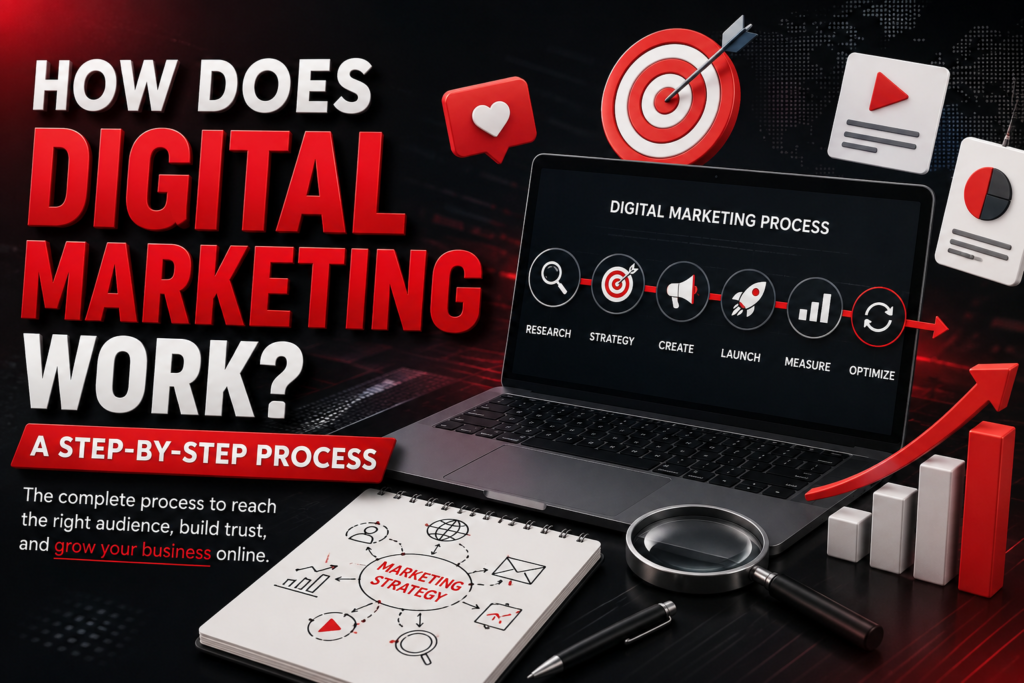
If you want to know how does digital marketing work it is not one thing it is a system that is all connected. A business looks at the people they want to sell to, they make a plan, they make things like pictures and words they show these things to people, on the internet and other places. Then they see how it is all working and make it better based on what is really happening. Each part of marketing depends on the part that comes before it, like digital marketing itself. Digital marketing is a system where everything is linked together.
A lot of beginners (and honestly, a lot of business owners) picture digital marketing as “posting on Instagram” or “running a few Google ads.” In reality, those are just individual tactics sitting inside a much bigger digital marketing process. Skip the earlier steps — research, goal-setting, audience clarity — and even a well-executed ad campaign will underperform.
This guide breaks the entire digital marketing process down into clear, practical steps, so you understand not just what happens, but why each stage matters.
What Is Digital Marketing, Really?
Digital marketing is the practice of promoting a brand, product or service through channels. Search engines, social media, email, paid ads and websites. With the goal of reaching the right audience and turning them into customers.
What makes it different, from marketing is measurability. Every click, impression and conversion can be tracked, which means strategy can be adjusted in near time instead of waiting for a campaign to fully run its course.
How Does Digital Marketing Work? The Process Step by Step
Here’s how the process typically flows from start to finish.
1. Research and Audience Analysis
- Nothing good is created without research first. This part is, about learning:
- Who the people we want to reach really are (not age or location but what they want and what problems they have)
- What other people are doing right or wrong
- What words and phrases people use when they search online
- Where people spend their time on the internet
Not doing this step is one of the reasons campaigns don’t work well. The message becomes the same for everyone because it wasn’t made for a real person’s problem.
2. Setting Clear And Measurable Digital Marketing Goals
When we know who our audience is the next thing we need to do is figure out what we want to achieve. To do this we need to define what success means to our marketing efforts. Most digital marketers use something called the SMART framework to set their marketing goals. This means our digital marketing goals should be Specific, Measurable, Achievable, Relevant and Time-bound.
Here are some examples of digital marketing goals:
- Increase the number of people visiting our website from search engines by 30 percent in six months
- Get 100 potential customers to sign up through paid search every month
- Add 2,000 people to our email list this quarter
If our digital marketing goals are not clear like just saying “we want to get more sales” then it is really hard to know if our digital marketing strategy is actually working for our digital marketing efforts. We need to set digital marketing goals so we can track progress and make changes to our digital marketing strategy as needed for our digital marketing.
3. Choosing the Right Channels
Not every business has to be, on every platform. The choice of platform depends on where the target audience’s already spending their time and what part of the buying process the target audience is in. Some common types of platforms that businesses use include:
| Channel Type | Examples | Best For |
| Owned | Website, blog, email list | Long-term trust, conversions |
| Paid | Google Ads, Meta Ads | Fast, targeted results |
| Earned | PR, word of mouth, shares | Credibility and reach |
| Organic Social | Instagram, LinkedIn, TikTok | Brand awareness, engagement |
A common mistake is spreading budget and effort across too many channels too early, instead of mastering one or two that actually reach the audience.
4. Content and Campaign Creation
This is where strategy becomes something the audience actually sees — blog posts, ad creatives, social content, email sequences, landing pages. Good content at this stage does two things at once: it serves the reader’s actual need, and it’s built around the keywords and topics identified during research using effective on-page SEO optimization techniques.
5. Launching Campaigns
So we have our content and channels all set. Now it is time to launch the campaigns. This is when we actually publish our search engine optimization content start a Google Ads campaign plan out our social content calendar or send out a series of emails. We finalize the timing of the campaigns figure out who our audience is and decide how to allocate our budget for the campaigns.
6. Tracking and Measuring Performance
Tracking and measuring performance is one of the parts of digital marketing. It is much better than marketing because almost everything can be tracked. Important numbers to watch include the number of people visiting the website and where they come from. Also the percentage of visitors who take the desired action is important. The cost for each click and the cost to get a customer are also key. How people interact with content on social media matters a lot. The rate at which emails are opened and clicked on is another factor. Tools such as Google Analytics, Google Search Console and the dashboards from ad platforms, like Meta Ads Manager and Google Ads are usually used for this purpose.
7. Optimization and Iteration
A marketing campaign is never really finished after it starts. The people in charge look at the information they get from the campaign. They use this information to make changes to who they’re trying to reach with their ads. They also make changes, to the ads themselves update the parts that are not doing well and move their money to the things that are actually working. This is something that marketers have to keep doing. Marketing is something that goes around in a circle it is not something that you do one time and then you are done with it. Digital marketing is a cycle. The Optimization and Iteration of a marketing campaign is very important.
Common Mistakes That Slow Digital Marketing Down
- Starting to execute without doing research or setting goals
- Trying to be, on every platform instead of focusing on the channels that the audience uses
- Not looking at data after a campaign starts instead of using that data to improve
- Considering SEO and paid ads as completely different things when they actually perform best together
- Posting or running campaigns irregularly which makes it harder to build trust over time
Digital Marketing Strategy vs. Digital Marketing Techniques
People often use these two terms in the way but they are not the same thing.
- Digital marketing strategy is the overall plan — who you’re targeting, what channels you’ll use, and what results you’re aiming for.
- Digital marketing techniques are the specific tactics used to execute that strategy, like SEO on-page optimization, retargeting ads, or email automation sequences.
Digital Marketing Strategy and Digital Marketing Techniques need to work for Digital Marketing Strategy to be successful.
FAQs
How long does it take for marketing to show results? It really depends on the type of channel you are using. If you use paid ads you can see results in a few days.. If you are using search engine optimization or creating organic content it can take a few months usually around three to six months to really get going and see some real progress with digital marketing.
Is marketing a good idea for small businesses? Yes it is. Small businesses can really benefit from marketing because it is cheaper and more targeted than traditional ways of advertising like television or print ads for digital marketing.
How does digital marketing work for beginners? If you are a beginner and want to understand how does digital marketing works, start with research and set some goals. These are the steps and everything else depends on them. If you do not do these things right your digital marketing campaign will probably not work well and that is usually why digital marketing fails.
Do I need to use all of the marketing channels that are available? No you do not. It is usually better to focus on a few digital marketing channels where your audience is actually active rather than trying to use all of them and spreading yourself too thin, with digital marketing.
Conclusion: Bringing the Digital Marketing Process Together
So how does digital marketing work? It works as a process. Research, strategy, content, execution, measurement and optimization. Not a single tactic. Businesses that treat marketing as a system rather, than a checklist of random activities are the ones that see consistent compounding growth over time.
If you’re just starting out don’t try to do everything at. Pick one or two channels that make sense for your audience get the fundamentals right and build from there.