Most on-page SEO tips you find online seem like a list copied from a guide. They tell you to write a description use your main word in the title add some text to images and that s it.
I’ve run my website and written content for two years. I didn’t just read about SEO; I actually did it page by page. I saw what worked and what didn’t.
Here’s what I found out: most SEO rules aren’t wrong. They’re not complete either. On-page SEO isn’t a one-time task. It’s a series of choices you make each time you publish. The ones that really improve rankings are often simple.
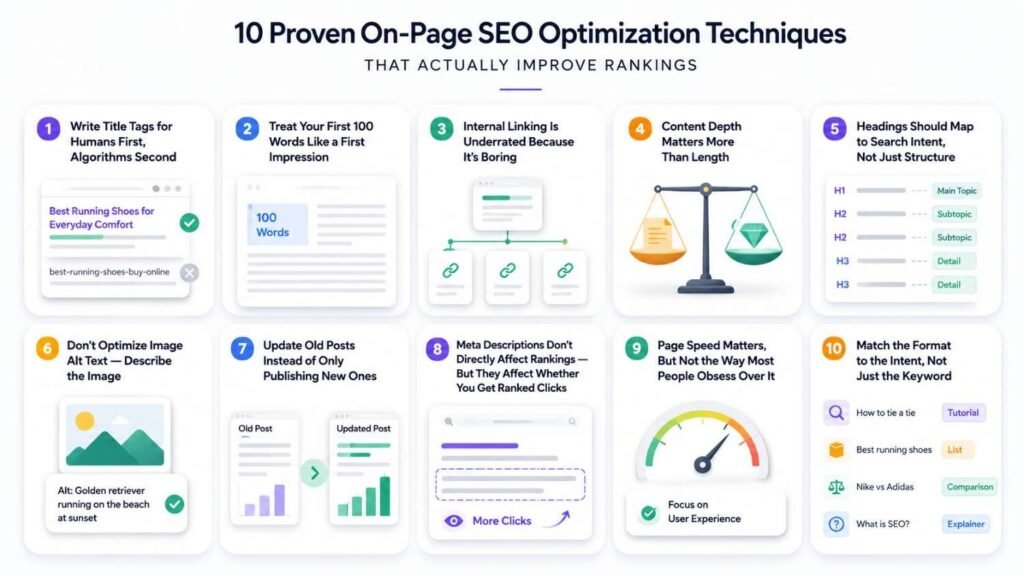
Here are 10 Proven On-Page SEO Optimization Techniques that I use. I don’t do them because some guide said to; I do them because I saw them work on my pages.
They are not, in any order just things I do.
Below are the techniques.
1. Write Title Tags for Humans First, Algorithms Second
The idea that you should “put your main word in the title” is correct but it does not really help you that much on its own. What really matters is whether someone looking at ten search results on Google will choose yours over the nine.
I used to write titles like “On-Page SEO Techniques – Complete Guide”. Now I write titles that promise something specific. A title that tells someone searching what they will get. A number, a time a result. Gets more clicks than one that just has a lot of keywords. Google pays attention to what people click on. If you have a title, with the keyword that nobody clicks it is not helping you.
The main thing to remember is to put your keyword near the beginning of the title but try harder to make the title sound like something a real person would write, not something a computer generated to follow some rules. Strong title tags are one of the most important On-Page SEO Optimization Techniques because they improve both relevance and click-through rate.
2. Treat Your First 100 Words Like a First Impression, Not a Keyword Slot
When you start writing, think about your 100 words as the first time you meet someone. You want to make an impression. A lot of people say you should get your topic into those first 100 words. That is an idea.. I used to make mistakes. I would start my posts by saying the thing over and over. I would write a paragraph that said the thing, as the title. Then I would write “in this post we will talk about” and then another paragraph before I actually said something
People who read my posts and even search engines would stop reading because of that. Now I try to say something right away in the first paragraph. My main topic fits in naturally because I am actually trying to answer a question, not just fill up space with the topic.
One of the simplest On-Page SEO Optimization Techniques is making sure readers get value within the first few sentences.
3. Internal Linking Is Underrated Because It’s Boring
If there’s one thing I’d tell someone starting out, it’s this: internal linking does more quiet, compounding work than almost anything else on this list, and almost nobody treats it seriously.
It’s tempting to write a post, publish it, and move on. But going back through your older content and linking new posts to relevant old ones — and old posts to new ones — helps Google understand your site’s structure and helps your best pages absorb authority from related ones. It’s not exciting work. It’s also one of the few things that’s entirely within your control, doesn’t require backlinks from anyone else, and costs nothing but time.
Internal linking remains one of the most overlooked On-Page SEO Optimization Techniques, even though it is completely within your control.
Practical tip: Every time you publish something new, go find three to five older posts on related subtopics and add contextual links — not “click here,” but links embedded naturally in a sentence that’s actually about that topic.
4. Content Depth Matters More Than Length
People often think that longer content ranks better.. This is only partly true. I’ve seen 3,000-word articles that don’t say much.
The truth is, content length is a result of having depth not the reason, for rankings.
What works for me is writing until the topic is fully covered. I make sure someone can get their answer without opening another tab.
Then I stop writing. Sometimes my articles are 800 words. Times they are 2,500 words. The hard part is not adding words just to reach a certain number. Readers can easily spot content. Among all On-Page SEO Optimization Techniques, writing content with real depth consistently produces better long-term results.
Googles systems can too.
5. Headings Should Map to Search Intent, Not Just Structure
H2s and H3s are not just, for arranging your ideas. They show what questions your content answers. Before writing a post I research what people are searching for on the topic. I look at questions “people also ask” sections and forum discussions. Then I organize my headings around those questions. I don’t just structure my headings based on how I would explain the topic. This approach does two things. It makes the post easier to scan. It also increases the chance that a specific section will be used as a featured snippet. This is because the heading often matches what the person is searching for.
Organizing headings around search intent is one of the On-Page SEO Optimization Techniques that can improve both readability and visibility.
6. Don’t Optimize Image Alt Text — Describe the Image
Do Not Optimize Image Alt Text. Describe The Image
I do not think it is an idea to use alt text to add keywords. Many SEO tips say to do this. I disagree. The main purpose of alt text is to help people who cannot see images. This includes people who use screen readers and those who have images turned off.
When you write alt text that actually describes the image it usually ends up being relevant. It does not sound like it was written for a computer.
Here is what you should do: write alt text like you are describing the image to someone who cannot see it. If your keyword fits in naturally that is great.. If it does not fit then just leave the Image Alt Text blank. Write Image Alt Text to describe the image. That is what Image Alt Text is, for. Good accessibility should always be part of your On-Page SEO Optimization Techniques, not just keyword optimization.
7. Update Old Posts Instead of Only Publishing New Ones
I used to think that I should only focus on writing posts.. Then I realized that updating old posts is also very important. When you write something and publish it you should not just forget about it. Move on to the next thing. The truth is that search results on the internet change all the time. Your Old Posts will also change because you will learn more about the topic you are writing about.
The pages that you thought were good enough a year and a half ago are probably not good enough now. So it is an idea to go back and update your Old Posts. You can make them better by fixing the way they are organized and adding sections that are missing. You should also update anything that is related to time like dates or events.
Updating Old Posts is a good use of your time because you are making something better that is already popular. This is better, than starting from scratch with a post because your Old Posts already have some authority and people respect them. Updating older content is one of the On-Page SEO Optimization Techniques that many website owners overlook.
8. Meta Descriptions Don’t Directly Affect Rankings — But They Affect Whether You Get Ranked Clicks
This trips people up. Google has been fairly clear that meta descriptions aren’t a direct ranking factor. But that misses the point: a meta description is your pitch in the search results. A weak one means fewer clicks even if you’re ranking in a good position, and click-through behavior absolutely factors into how your page performs over time. Writing compelling meta descriptions complements your On-Page SEO Optimization Techniques by improving click-through rates.
I write meta descriptions like ad copy — what’s the one sentence that makes someone choose this result over the other nine.
9. Page Speed Matters, But Not the Way Most People Obsess Over It
There’s a lot of anxiety around Core Web Vitals scores. My take: speed matters as a baseline — if your page is genuinely slow, fix that — but chasing a perfect Lighthouse score while your actual content is thin or generic is solving the wrong problem first. Content quality and relevance still carry far more weight than shaving off another quarter-second of load time.
Page speed should support your On-Page SEO Optimization Techniques, but it shouldn’t become your only focus.
10. Match the Format to the Intent, Not Just the Keyword
This is probably the technique most guides skip entirely. Before writing anything, I check what format is already winning for that search term — is it listicles, is it a single definitive guide, is it comparison tables, is it short direct answers? Writing a 2,000-word narrative essay for a query where every top result is a quick comparison table is fighting the intent of the searcher, not just the algorithm. Matching content format to search intent is one of the most effective On-Page SEO Optimization Techniques you can apply before writing.
Takeaway: Look at what’s already ranking before you decide what shape your content should take. Intent match is on-page SEO too — it just happens before you write a single word.
Common Misconceptions Worth Retiring
“More keywords means rankings” is not true. The importance of using the keywords over and over again is not what it used to be years ago. What really matters now is that the text is relevant and easy to understand not how times we use the same keywords.
“Longer is always better” is another misconception. It is not about how the text is, but, about how much information it provides.
“Alt text is a keyword opportunity” is also not correct. The main purpose of alt text is to help people who cannot see the pictures so we should use it for that reason. Alt text is an accessibility feature foremost so we should treat it that way.
FAQs
How long does on-page SEO take to show results? It usually takes weeks to see results, not days. The time it takes depends on how competitive the topic’s how established your website is.Don’t look at a 2-day traffic graph to judge if a change worked.
Should I rewrite content or just publish new posts? Do both.. If you have to choose, updating old content that is already, on search engines and getting some traffic is often the quickest win.
Do I need to hit a keyword density? No you do not. Just write in a way. Make sure your topic and purpose are clear. Let the keyword appear when it makes sense not to meet a certain percentage.
Final Thoughts
None of this is hard. That’s kind of the point. On-page SEO Optimization Techniques is not a trick. It’s about making each page clear, helpful and well-organized all the time. The methods that really improve rankings are usually not secrets. They are just easy to ignore when you want to publish
If you only take one thing from this post: go fix your links and look at one old page this week. It may not be exciting. It works.